Regulation on the AI Act – a new approach to artificial intelligence


In recent years many new technologies have emerged that use artificial intelligence solutions. They evoke both admiration due to their growing capabilities and concerns about their use for improper purposes. That is why the European Union has decided to regulate the use of AI. What is this regulation, who does it apply to, and what does it mean for users? We explain!
What are the AI Act regulations?
The AI Act or the Act on Artificial Intelligence is the shortened name of Regulation (EU) No 2024/1609 of the European Parliament and of the Council of 13 June 2024.
The main aim of the regulation is to establish legal and organizational frameworks for solutions utilizing AI technology within the European Union. The creators of the AI Act assume that artificial intelligence should be a tool serving the good of humanity and should not violate its fundamental rights, which the European Union is committed to protecting.
Among the protected values, there is, among others, intellectual property. Therefore, the AI Act also includes content generators. They have been divided into two categories.
- General-purpose AI models – AI model producers will be required to obtain consent to use copyright-protected materials and maintain transparency requirements.
- General-purpose AI models with increased systemic risk – will be subject to tests and security controls, among others. Their creators will also be required to disclose data from technical documentation.
The regulation speaks both about AI systems and AI models. What is the difference between them?
System AI
The AI system, in the understanding of the AI Act, is any product or program that relies on artificial intelligence, either entirely or partially, for its operation. Its main characteristics are:
- operation using machines;
- ability to draw conclusions based on provided data;
- partial ability to operate without human intervention.
Model AI
The software on which the machine learning process is carried out based on various strategies is referred to as an AI model. The regulation lists several types:
- Supervised learning – that is machine learning through examples. This method uses two types of data: input and output. The AI model uses input data to deduce the output data using regularities.
- Unsupervised learning – it involves independently searching for connections by the tested software and presenting the results.
- Reinforcement learning – it requires providing the program with only output data. The task of the AI model is to find as many logical connections between them as possible.
In order to talk about an AI system, an AI model requires, among other things, a user interface. This means that in the context of the AI Act, a model is not the same as a system.
Who do the regulations of the AI Act apply to?
The AI Act applies to various degrees to individuals utilizing artificial intelligence in their everyday activities.
Among them are:
- suppliers of AI systems or general-purpose AI models in the EU;
- entities using AI systems that are headquartered or physically located in the EU;
- suppliers and other entities using AI if the results generated by artificial intelligence are utilized within the Union;
- importers and distributors of AI systems;
- manufacturers of products utilizing AI systems;
- representatives of AI companies based outside of the EU;
- other actual and potential users of AI.
However, the greatest responsibility lies with the providers of AI solutions. It is the individuals implementing AI solutions who must ensure the ethics, security, and transparency of the applied solutions.
Failure to comply with the provisions of this regulation will be subject to a financial penalty, the amount of which is specifically determined in the regulation.
Who is not affected by the AI Act?
However, it is worth knowing that the regulation does not apply to certain AI systems. These are solutions (or their outcomes) that are used exclusively for the purposes of:
- defensive,
- military,
- scientific,
- developmental,
- testing before circulation,
- national security,
- personal non-professional activity.
The AI Act also does not apply to AI systems operating on the basis of free open source licenses unless they are considered high-risk systems.
See also
What does the introduction of the AI Act change?
The AI Act imposes a number of obligations on businesses and individuals who use artificial intelligence solutions. Each AI system is classified according to its potential risk.
The regulation distinguishes four levels on which a given AI technology can be found:
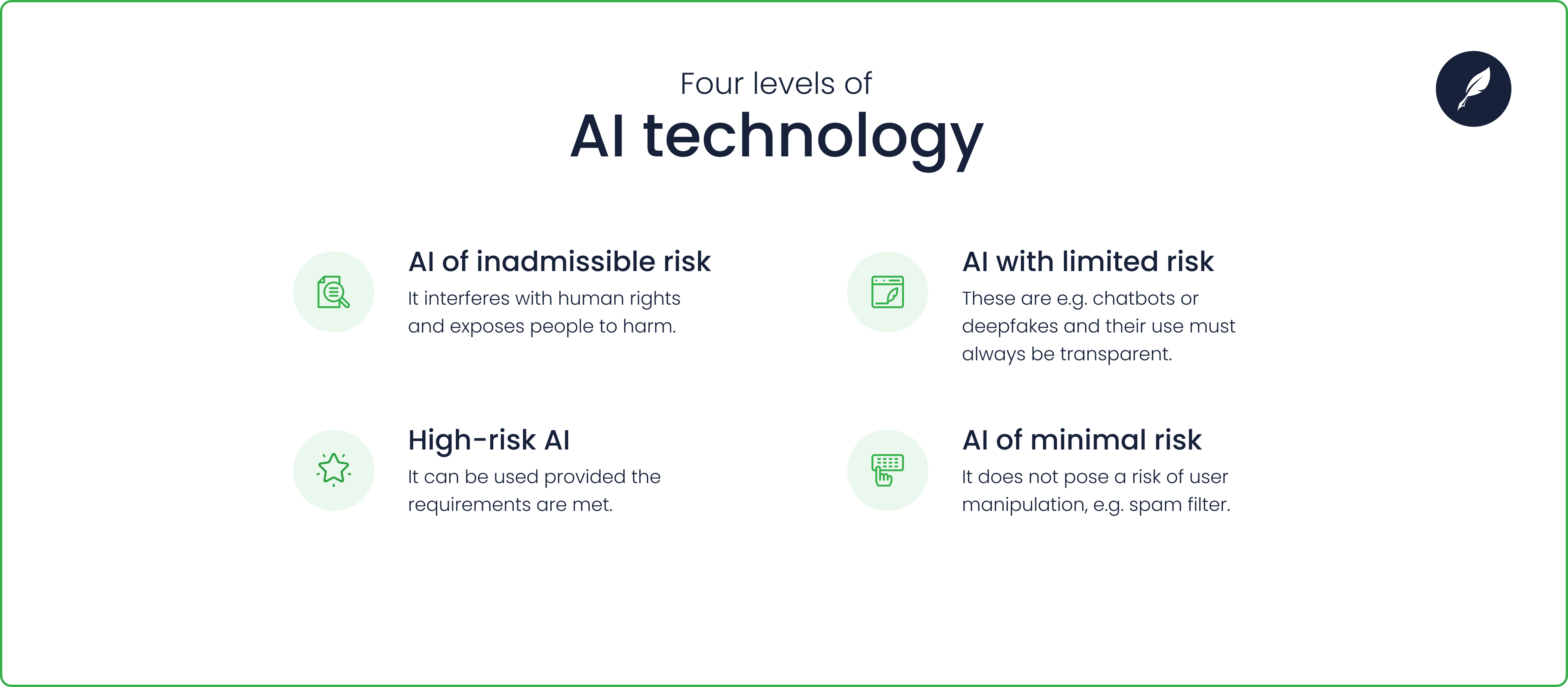
AI of inadmissible risk
These are all AI systems that interfere with human rights and expose them to harm or unequal treatment.
Examples of such solutions are AI:
- using subliminal messaging, manipulation or deception to influence human behavior;
- potentially exposing individuals with disabilities, minors or the elderly to harm;
- using a scoring system to assess individuals;
- assessing the risk of committing a crime based on someone’s appearance and character traits;
- evaluating a person’s emotions, racial background, political views, union membership, or sexual orientation;
- obtaining a person’s images from illegal sources (referred to as untargeted scraping).
The regulation specifies exceptions related to medical purposes or the search for criminals.
High-risk AI
High-risk AI is permissible provided that the supplier meets a series of requirements. They are intended to reduce the risk of unauthorized use. Some of the obligations include:
- possession of a quality management system;
- fulfillment of registration obligations;
- ensuring compliance of a high-risk AI system with accessibility requirements;
- placement of the CE marking on packaging or within the system;
- placement of a trademark symbol and contact address.
Examples of high-risk systems include programs for selecting recruitment documents in the recruitment process based on keywords, credit scoring systems, and systems for classifying emergency calls.
AI with limited risk
The most well-known systems of limited risk are chatbots and deepfakes which involve overlaying someone’s voice or face onto another photo or video. Entities using these systems have a duty to inform users that their operation is based on artificial intelligence. This is particularly important in the case of deepfakes, which in some situations may expose the creator to criminal liability.
AI of minimal risk
This category includes AI systems that do not pose the risk of user manipulation, such as spam filters. The creators of these systems only need to adhere to general recommendations.
When did the new regulations come into force?
The AI Act Regulation came into force on 01.08.2024.
Its entries will be implemented gradually to allow all interested parties to adapt to the changes.
Implementation process of AI Act
This is how the implementation process of the AI Act is presented:
- After 6 months (from 2.02.2025), after the regulation comes into force, the general provisions will become binding, and AI solutions from the category of unacceptable risk will be officially prohibited.
- After 12 months, provisions regarding supervisory authorities in individual countries, penalties for non-compliance with the provisions of this regulation and general-purpose AI systems will come into effect.
- After 24 months (i.e., 2.08.2026), member states, entrepreneurs, and individuals will be obliged to comply with all provisions.
How to use artificial intelligence wisely?
Despite the wide range of possibilities and promising prospects, artificial intelligence can use provided data for improper purposes or mislead the user. How to remain vigilant?
Verify the information
Not all information conveyed by artificial intelligence is up-to-date and true. This happens because AI systems are based on a limited knowledge base. In situations where they do not know the answer, they will generate a scenario that is most likely, but not necessarily in line with the facts. If you are looking for information, only use reliable sources.
See also
Use in moderation
As the authors of the Artificial Intelligence Act point out, it is only a tool in service of humans. Mindlessly replicating the outcomes of AI work does not serve the purpose of broadening horizons, but rather creates a greater risk of vulnerability to manipulations. In an era of spreading misinformation that can influence the behavior and decisions of others, having a healthy common sense is extremely important.
Remember about responsibility
Deepfakes can have surprising effects in many situations, but they should be used wisely. In the UK, their misuse is subject to legal regulation, particularly in cases involving privacy violations, fraud, or reputational harm. Unauthorised use of someone’s likeness may result in legal consequences, including financial penalties or criminal liability.
Summary
- The AI Act is a binding regulation of the European Parliament, which is the first in the world to define the principles of using artificial intelligence.
- Although the regulation mainly applies to AI system producers, it also applies to government bodies and individuals.
- Artificial intelligence tools are divided into prohibited AI (with unacceptable risk), high-risk AI, limited-risk AI, and minimal-risk AI.
- Content generators are divided into general-purpose AI models and general-purpose AI models that pose a greater systemic risk.
- To use technological advancements sensibly, it is important to maintain a critical approach, practice moderation, and be aware of responsibility.









Leave a Reply